Walking Out, Walking Into
Bianca Stoppani
Thoughts circumambulate on a cab hurled to Glasgow. It heavily rains. The intensity of the past days is compressed in my guts, the same I have to hold on to when the car slides over extended patches of water and can’t brake. I, the driver, an orchestra director, a student, the car, the road are temporarily assembled with conditions of tiredness, traffic, and the dark, wet, non-linear morphology of this time-space that separates us from our destination.
For nine days, I did not sleep. Though I know that such cases are on record, for years afterwards I took my lack of sleep as the most solid argument for the reality of the forces with which we experimented. I wasconstantly thinking in a rich, calm, image-filled way.
This mood undoubtedly affected my reaction to the bizarre mirage which burst upon us from the increasingly opalescent zenith as we drove near the Cairngorms plateau and began to make out the cumulative undulations of the foothills. I had seen dozens of mirages during the preceding weeks, some oft hem quite as uncanny and fantastically vivid as the present sample, but this one has a wholly novel and obscure quality.
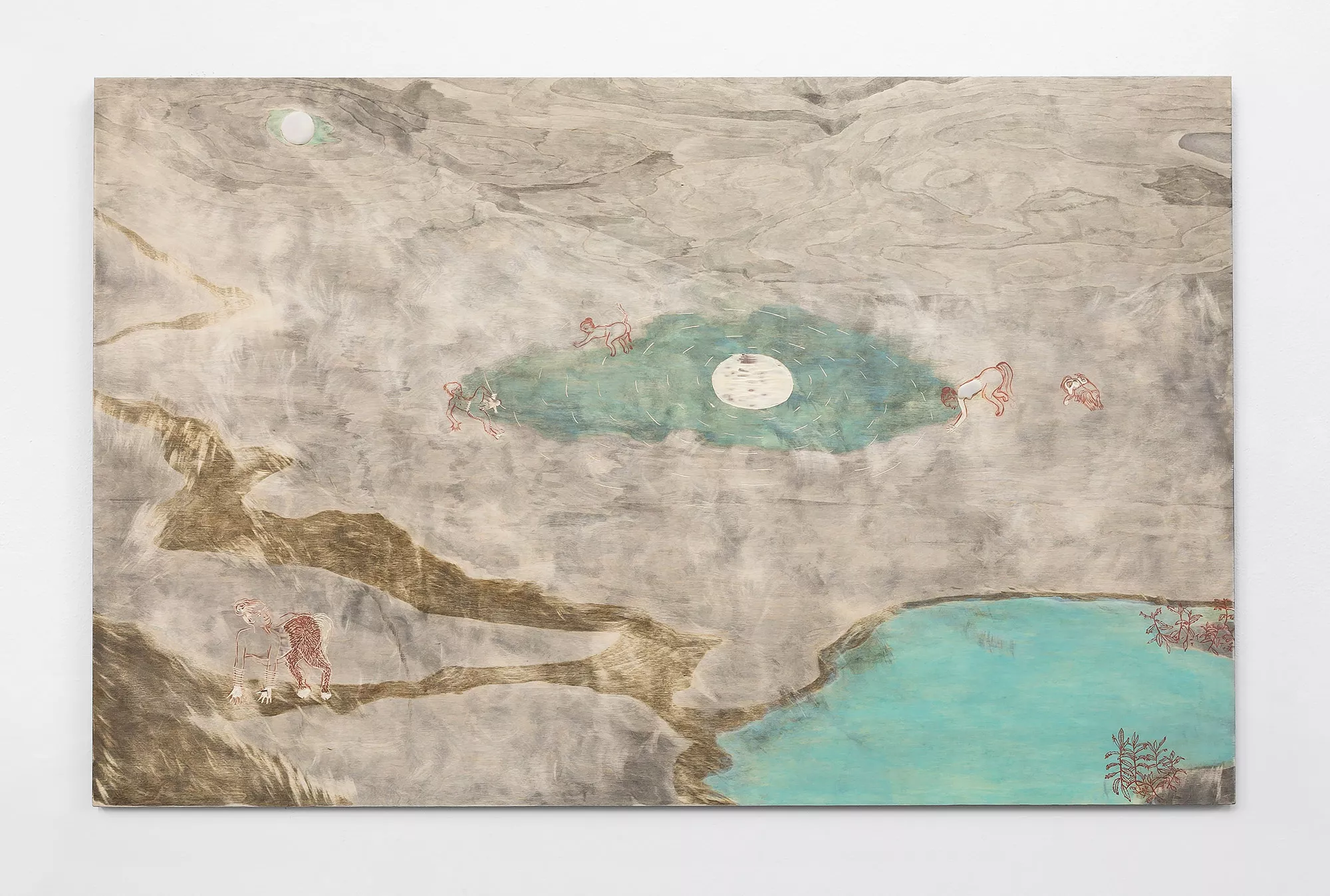
The moon reflects its image in a copper oxide loch which is delimited by a thick mist. The clear water is at my knees, then at my thighs. How clear it was only this walking into it could reveal. What I see underwater has asharper clarity than what I saw through the air. I wade into the brightness, and the width of the water increases, as it always does when one is on or in it. Then I look down, and at my feet there open a gulf of brightness so profound that the mind stops. I am standing on the edge of a shelf that runs some yards into theloch before plunging into the pit that is the true bottom. And through that inordinate clearness, I see to the depth of the pit.
I wade slowly back into shallower water. There is nothing that seems worth saying. My spirit is as naked as my body. It was one of the most defenceless moments of my life.
Looking up, the partly sanded wetlands are populated by small, red figures, showing features of women andbulls. One drinks, another has a bath, and another gives birth. The one on the far left walks down the peat street in a blind world, alone.
Night falls; the traveller must pass down village streets, and on out into the darkness of the fields. She goes west or north, towards the mountains, the city lights receding. I try to grasp their shape, but it is toodark. The place she goes towards is a place that I cannot describe at all. It is possible that it does not exist. But she seems to know where she is going.
It is not clear if she is leaving behind her community or her past, for the other figures I see could be former instantiations of the same being. Or they may be a series of plant-lets — their different stages observed in a diorama — of the group of Bryophyllum daigremontianum on the right. Commonly called devil’s backbones,mothers of thousands, or alligator plants, these succulents can propagate vegetatively from young plants that develop on the margins of their leaves. They are also known for many medicinal applications; for example, they can be used against premature contractions with little side effects.
As is well documented, through the Middle Ages women had possessed knowledge about herbs and their healing as well as contraceptive properties. Mostly turned into potions and ‘pessaries’ (suppositories), they were used to quicken a woman’s period, provoke an abortion, or creating a condition of sterility. In Eve’s Herbs: A History of Contraception in the West, John Riddle has given us an extensive catalogue of the substances that were most used and the effects expected of them or most likely to occur. The criminalisation of contraception in the 16th and 17th century expropriated women from this knowledge that had beentransmitted from generation to generation, giving them some autonomy concerning child-birth.
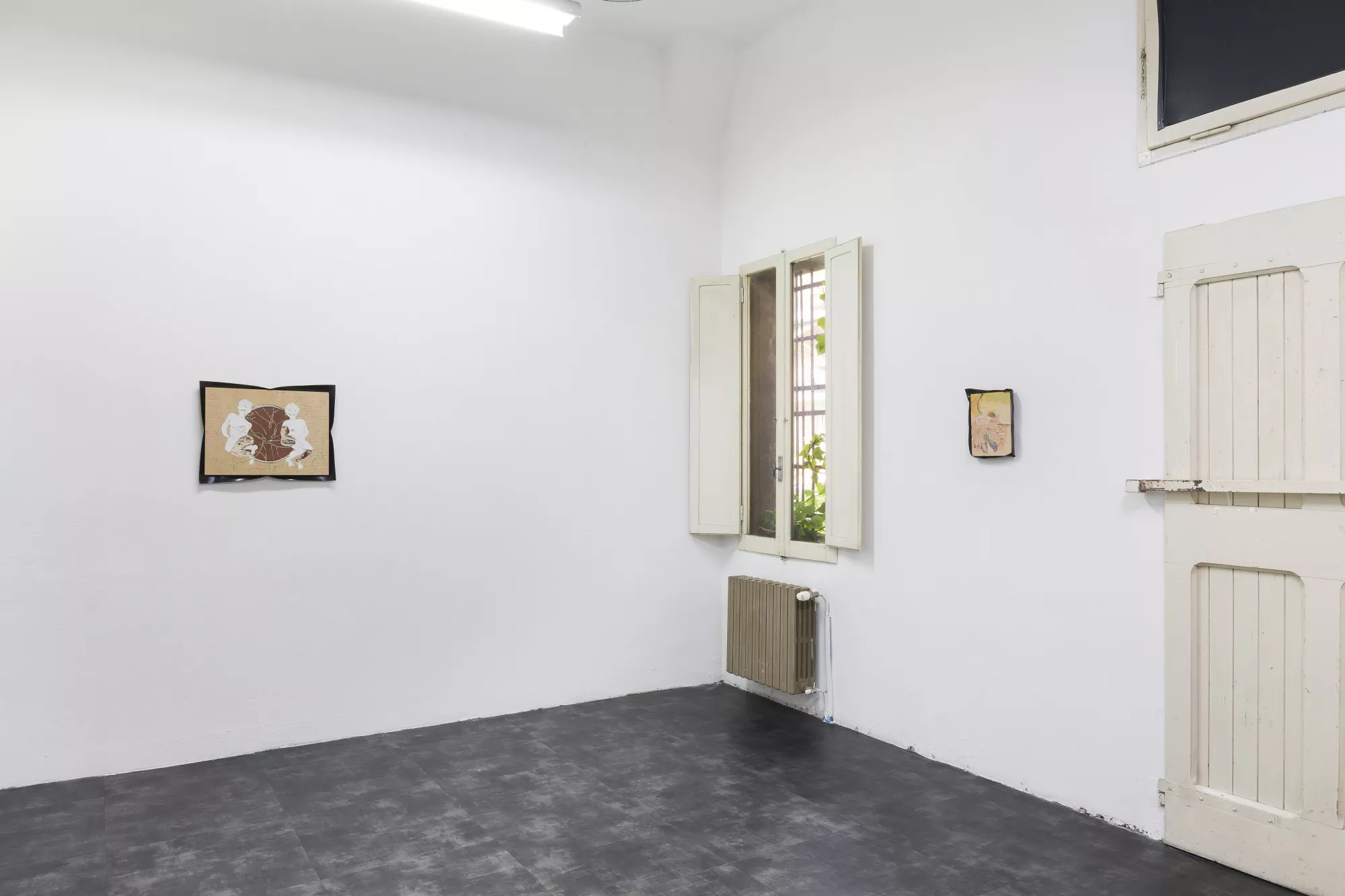
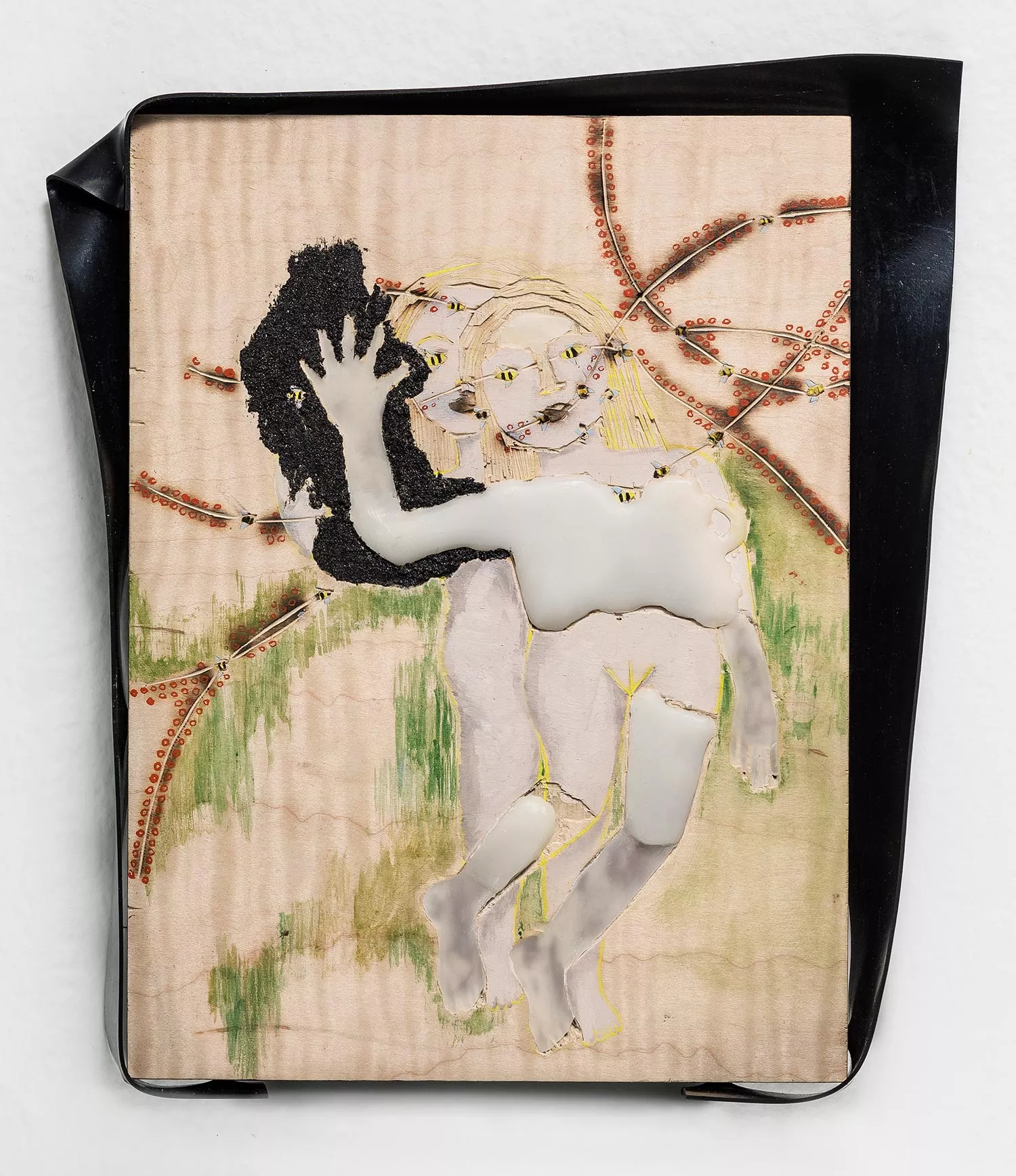
The mirage starts to break up and form again. The leaves of a sinuous Mimosa pudica, a creeping perennial flowering plant known in Ayurvedic medicine for its contraceptive properties, partners with and/or hold hostage the mouths of two female figures. Their leafy, hieratic smiles suggest secrecy: Who is going to speak, and who are they going to be intelligible to? White where their limbs have not been scratched or filled with wax, they float, moon-like, over a fertile, ferric oxide Petri dish. And yet, through this floating, purely exterior collision, the accident of their archaic symmetry produces a kind of semantic mirage: the deviance of meaning, which makes the two twins seem to be like two halves of a single self, of the same individual. Green inflorescences tenderly sprout all over, in a cosmic scene of reciprocal xenotransplantation.
Such genetic entanglement follows a logic of insertion and exchange, for they graft cells and information onto each other and, in so doing, they hybridise both species and narratives. On an affective level,they bring the perception of an alien limb or body within oneself to speak through. Whom truth will be articulated?
That genetic-linguistic trade had already been extended to the assemblages of fruits and hostages, taking centre stage on a gigantic Buddleia: commonly known as the butterfly bush, it is an invasive species with long, slender clumps of flowers, usually lilac but also blue, deeper purple or white, at the end of long, arching branches. Sprouting from seemingly every railroad track and derelict building, the plant can cause damage to crumbling brickwork, as its tiny wind-blown seeds can germinate in decaying mortar. In other words, it continually re-narrates the unfolding of time.
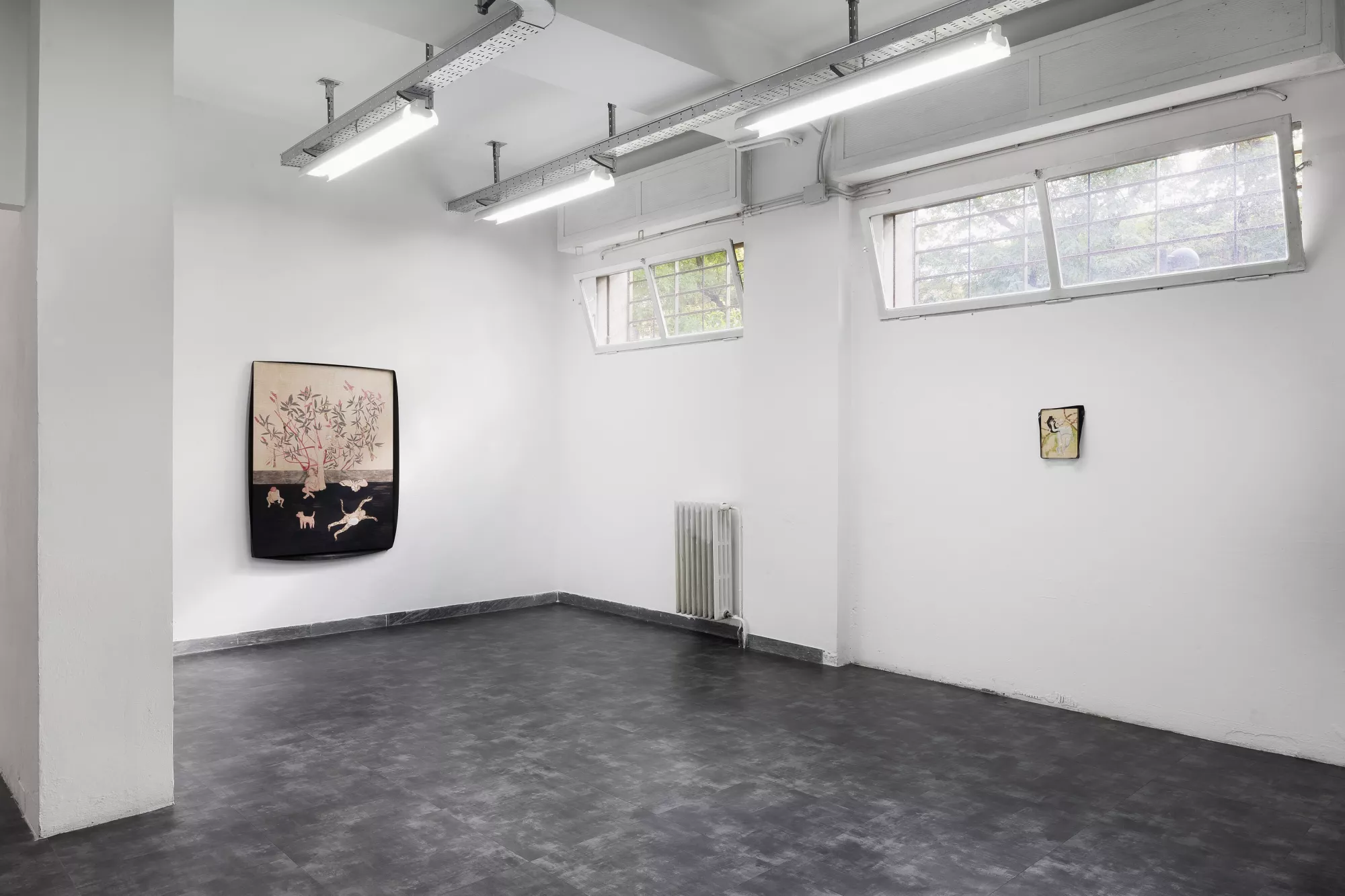
Panicles with flowers or humanoids are hung from the Buddleia’s branches, while a woman, a boy, adog, and a pregnant monkey detach themselves from a black background. With a simultaneous shift, archaism and futurism conflate in this anti-speciesist contrafiction, revealing that the production oforganisms and words very much merges the past, present, and future in intricate time loops and holes.
Such multispecies collaborations and multitemporal storytelling exceed the concept of progress; and yet they make worlds. These phenomena are what outlive capitalism, what its agenda of zombification is blockedfrom. It is the ‘third nature’ Anna Lowenhaupt Tsing writes about: if the ‘first nature’ includes ecological relations and ‘second nature’ points to the capitalist modifications of the environment, then the ‘third nature’ is what achieves to live notwithstanding capitalism. Tsing maintains this in her book The Mushroom at the End of the World. On the Possibility of Life in Capitalist Ruins, where she gives a polyphonic account of matsutake, the most valuable mushroom in the world, yet living in human-disturbed environments. By saying this, Tsing means that matsutake grows with red pine, which germinates in the empty spaces and soils rich in minerals caused by human deforestation. Therefore, matsutake shows the possibility of a collaborative, albeit precarious, survival not only because of its ecology, as it nurtures and helps forests growing in discouraging places, but also because of its commerce, as it sustains a complex array of pickers, who are often displaced cultural minorities. It thus allows changeable assemblages of non-humans and humans and complicates in so doing the capitalist transformation of those actors in stand-alone, raw resources1.
The capitalist logic of alienation does not only affect the environment, economy, and society, but also the psyche. Many different bodies are currently segregated and minds are privatised. It does not come as asurprise that the possibility of participating in, or realising of, or even dreaming about, a group consciousness becomes limited. The real is made not to be perceived as contingent like it should be, so that it is incrediblydifficult to imagine an alternative to it. Such is the cause-effect of capitalism realism: the ideological real set in place by neoliberalism is meant to generate a consciousness deflation and, consequently, to thwart any possibility to imagine2. This means that we are stripped of the time-spaces to make sense and recombine the elementals we live through: overstimulated, we want instead to be inoculated.
In his latest, and unfinished work called Acid Communism, Mark Fisher starts examining the use of psychedelics and the formation of a new politics in the 1960s and 1970s. He maintains that the crucial defining feature of the psychedelic is the question of consciousness and its relationship to what is experienced as reality. If the very fundamentals of our experience, such as our senses of space and time, can be altered,does that not mean that the categories by which we live are plastic, mutable?. Acid communism is then a project of consciousness expansion, one that points towards a desire for postcapitalism consensually shared by a collective subject yet to be constructed3.
Walking out of our faces and into our collective consciousness makes possible to transcend the realism we are embedded in as well as to dissolve the boundaries of the neoliberal, mandatory individualism. Walking out of her human body and into the non-human Cairngorms plateau provided Nan Shepherd access to a whole different reality. Shepherd realised that mountains and deserts are no landscapes but worlds in themselves,producing magnificent examples of fantastic and weird images. Sun dogs, fog bows, and Brocken spectres were ‘mis-spellings’ to her, that is visual errors that possess an accidental magic and offer unlooked-for revelations. Those visions are a means of re-evaluating our experience and interpretation of the structures we live in precisely because they demonstrate that our habitual vision of things is only one of an infinite number.
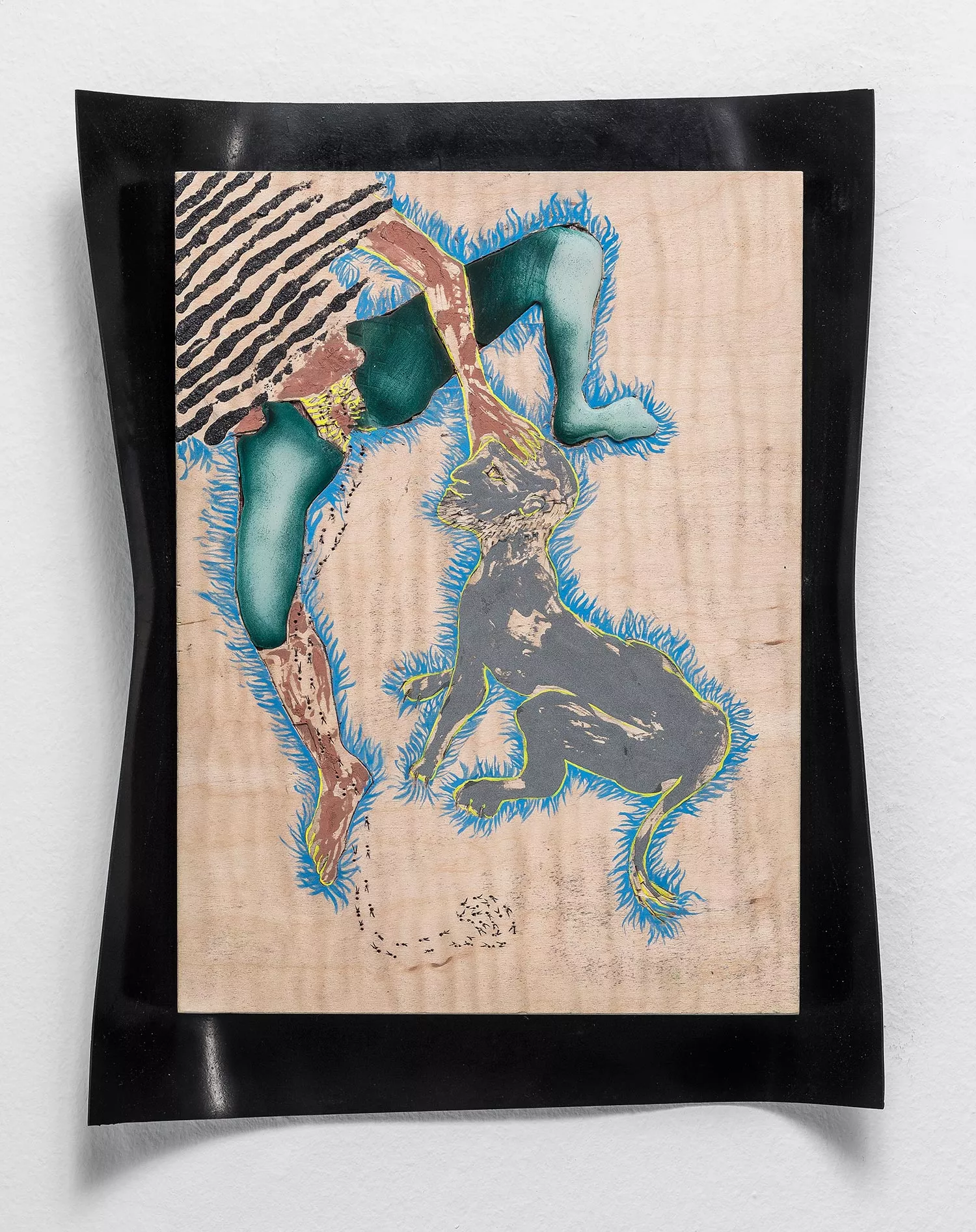
Pondering about Shepherd’s inner geopoetics, I see myself couched, and bird footed. In early Greek art, Sirens were represented as birds with large women’s heads, bird feathers and scaly feet. I am watching agroup of deer. The air is dry; there is no time, nor shadows. I feel my back pricked by a porcupine quill and softened by wax. And there I am, with dedomesticated senses, between the fire of the rock and the fire of the sun, scree, soil and water, moss, grass, flower and tree, insect, bird and beast, wind, rain and snow; the lungs crackle and I come back to the car window, from my journey into being.
Text published for Fugazza's solo exhibition Hostages and Friends at Gallleria Più, 2019.
1 See Anna Lowenhaupt Tsing, The Mushroom at the End of the World. On the Possibility of Life in Capitalist Ruins (Princeton, N.J.: Princeton University Press, 2012), viii; 19
2 See Plan C, ‘Building Acid Communism’, 2018 https://transmediale.de/content/building-acid-communism
3 See Matt Colquhoun, ‘Acid Communism’, Krisis - Journal for Contemporary Philosophy, no. 2 (2018), https://krisis.eu/acid-communism/
Notes
“For… nine days, I… sleep. Though I know that such cases are on record, for years afterwards I took my lack of sleep… as the most solid argument for the reality of the forces with which we experimented. […] I was constantly thinking in a rich, calm, image-filled way…”: Terence McKenna, True hallucinations: Being an Account of the Author’sExtraordinary Adventures in the Devil's Paradise (San Francisco: HarperSanFrancisco, 1993), 100
“This mood undoubtedly… my reaction to the bizarre mirage which burst upon us from the increasingly opalescent zenith as we drove near the… and began to make out the cumulative undulations of the foothills. I had seen dozens of… mirages during the preceding weeks, some of them quite as uncanny and fantastically vivid as the present sample, butthis one has a wholly novel and obscure quality…”: H. P. Lovecraft, ‘At the Mountains of Madness’, The H. P. LovecraftArchive, 1936, http://www.hplovecraft.com/writings/texts/fiction/mm.aspx, 11
“The clear water… at… knees, then at… thighs. How clear it was only this walking into it could reveal. […] What… asharper clarity than what… saw through the air. …into the brightness, and the width of the water…, as it always does when one is on or in it… Then I… down, and at my feet there… a gulf of brightness so profound that the mind… …standing on the edge of a shelf that… some yards into the loch before plunging… the pit that is the true bottom. And through that inordinate clearness, …to the depth of the pit. […] …slowly back into shallower water. There… nothing that… worth saying. My spirit… as naked as my body. It was one of the most defenceless moments of my life”: Nan Shepherd, The Living Mountain (Edinburgh: Canongate, 2014), 12-13 “in a blind world”: Ibid. 44
“Night falls; the traveller must pass down village streets, …and on out into the darkness of the fields. …west or north, towards the mountains… The place… towards is a place… I cannot describe at all. It is possible that it does not exist. But… to know where… going”: Ursula K. Le Guin, ‘The Ones Who Walk Away from Omelas’, The Anarchist Library,1973, https://theanarchistlibrary.org/ library/ursula-k-le-guin-the-ones-who-walk-away-from-omelas.lt.pdf, 8
“Commonly called devil’s backbones, mothers of thousands, …alligator plants, …propagate vegetatively from… thatdevelop… […] …for… medicinal applications; …be used against premature contractions… little side effects”: ‘Bryophyllum Daigremontianum’ in Wikipedia, 28 June 2019, https://en.wikipedia.org/w/index.php?title=Bryophyllum_daigremontianum&oldid=903918405
“As is well documented, through the Middle Ages women had possessed… herbs… Mostly turned into potions and‘pessaries’ (suppositories), …were used to quicken a woman’s period, provoke an abortion, or creating a condition of sterility. In Eve’s Herbs: A History of Contraception in the West…, …John Riddle has given us an extensive catalogue of the substances that were most used and the effects expected of them or most likely to occur. The criminalisation of contraception… expropriated women from this knowledge that had been transmitted from generation to generation,giving them some autonomy concerning child-birth”: Silvia Federici, Caliban and the Witch: Women, the Body and Primitive Accumulation (New York, NY: Autonomedia, 2009), 92
“And yet, …this floating, purely exterior…, the accident… produces a kind of semantic mirage: the deviance of meaning…”: Jacques Derrida, Positions, trans. Alan Bass (Chicago, IL: University of Chicago Press, 1981), 46
“…makes the two twins seem to be like two halves of a single self, of the same individual…”: Jean Baudrillard, The VitalIllusion, ed. Julia Witwer (New York: Columbia University Press, 2001), 12
“long, slender clumps of flowers, usually lilac but also blue, deeper purple or white, at the end of long, archingbranches. […] Sprouting from seemingly every… derelict building… […] the plant can cause damage to… crumbling brickwork, …its tiny wind-blown seeds can germinate in decaying mortar”: Tanya Gupta, ‘The Plant That Dominates Britain’s Railways’, BBC News, 15 July 2014, sec. Magazine, https://www.bbc.com/news/magazine-28196221
“The crucial defining feature of the psychedelic is the question of consciousness and its relationship to what is experienced as reality. If the very fundamentals of our experience, such as our senses of space and time, can be altered, does that not mean that the categories by which we live are plastic, mutable?”: Mark Fisher, ‘Acid Communism (Unfinished Introduction)’ in K-Punk: The Collected and Unpublished Writings of Mark Fisher (2004–2016), ed. Darren Ambrose and Simon Reynolds (London: Repeater Books, 2018), 763
“‘mis-spellings’… visual ‘errors’ that possess an accidental magic and offer unlooked-for revelations”: RobertMacfarlane, ‘Introduction’, in The Living Mountain (Edinburgh: Canongate, 2014), xx
“our habitual vision of things is… only one of an infinite number”: Nan Shepherd, The Living Mountain (Edinburgh: Canongate, 2014), 101 “…between the fire of the rock and the fire of the sun, scree, soil and water, moss, grass, flower and tree, insect, bird and beast, wind, rain and snow…”: Nan Shepherd quoted in Robert Macfarlane, ‘Introduction’, in The Living Mountain (Edinburgh: Canongate, 2014), xxiii “the lungs crackle”: Nan Shepherd, The Living Mountain (Edinburgh: Canongate, 2014), 102